EV charger installation in Valencia
A charging point for the electric car in single-family homes —semi-detached or not— and in businesses, with its own circuit and the paperwork in order.
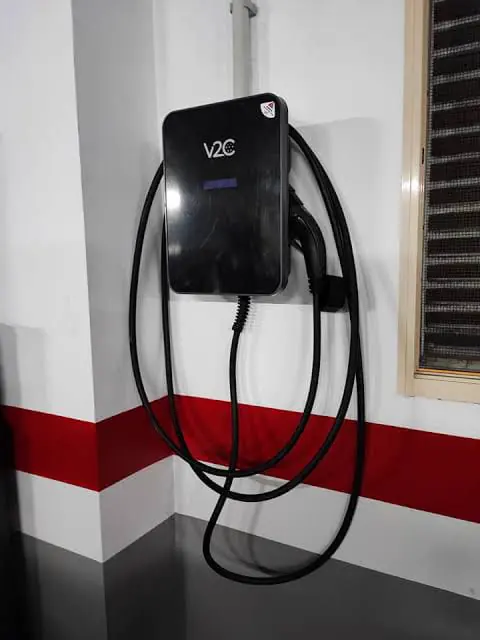
A charging point is not just the wallbox on the wall: it is the unit, the circuit feeding it and the protection that goes with it. Before sizing it, the contracted capacity is checked, along with the headroom the consumer unit leaves and the route of the cable, whether it is a single-family home —semi-detached or not— or a business.
Charging an electric vehicle falls under ITC-BT-52 and is closed with its CIE certificate. And if the house is drawing a lot while the car charges, the dynamic power controller is what keeps the limiter from tripping without having to upgrade the contracted capacity.
What it includes
- A study of the power available from the supply, before the wallbox is sized.
- A charging point for a single-family home —semi-detached or not— and for a business, with the wallbox fixed where the visit settles it.
- A dedicated circuit for the charging point, to ITC-BT-52.
- CIE electrical certificate and technical report, when the rating calls for them.
- Dynamic power controller when the installation needs one, so as not to exceed the contracted capacity.
How the work is done
- You tell me where the point goesOver WhatsApp: whether it is a single-family home —semi-detached or not— or a business, where the charging point would be and which car is going to charge there.
- I check the capacity and the consumer unitThe contracted capacity and the headroom in the consumer unit decide whether the point goes in as it is or needs the dynamic power controller so the limiter does not trip.
- It is settled on siteThe cable route and the exact position of the point are only settled by seeing the place. After that we agree what the work includes.
- Handed over with its certificateCharging is closed with the dedicated circuit for the point and the ITC-BT-52 CIE certificate.
What we do not do
- Subsidies are not processed and no current grant is promised: they change with every round.
- No installation date is promised.
Service area
I work in Valencia , Castellón and Alicante . The workshop is in Cheste and the base of work in Carlet , in the district of La Ribera Alta : from there the metropolitan area of Valencia and the neighbouring districts are close, and the rest of the three provinces is reached with an agreed visit.
If you are not sure whether I cover your municipality, message me and I will confirm it before anything is moved.
Tell me about your case
Message me on WhatsApp telling me what you need and, if you can, with a photo of what is already installed: with that I can tell you whether a visit is needed. You can also call +34 632 87 75 29 or write to info.serrenovables@gmail.com.
Message me on WhatsAppQuestions about this service
What is a wallbox and how is it different from a charging point?
The wallbox is the unit fixed to the wall that manages the car charging; the charging point is everything needed for that unit to work: the wallbox itself, the dedicated circuit feeding it, its protection and the socket or charging cable. That is why there is no one wallbox for every home: the power it can deliver is not decided by the unit alone, it is decided by the installation.
Do I need to legalise the electric car charger?
Every charging installation falls under ITC-BT-52. In a single-family home the charger goes on its own dedicated circuit and the installation is closed with its CIE certificate and, depending on the power, with a technical report; that is what is submitted to the industry department to register it.
What is the maximum power a house can have?
There is no legal cap in kW: what counts is the maximum admissible power on your CIE electrical certificate and the capacity of the grid. The 7.4 kW and 22 kW you hear about are charging steps (32 A single-phase and 32 A three-phase), not contractual limits. Single-phase reaches about 14.5 kW (63 A); three-phase is counted per phase. And in self-consumption, the power of the solar installation is the inverter’s, not the capacity you have contracted.
What is a dynamic power controller?
It is a system that measures what the house is drawing and lowers the charging power of the car when it has to, so as not to exceed the contracted capacity: the car charges without tripping the limiter and without upgrading the supply. In a single-family home with a single charger it is not mandatory; in an installation with several charging points it is what keeps the whole set from tripping.
Are there grants for installing an electric car charger in 2026?
MOVES III, which covered part of the installation, closed its application window on 31 December 2025, and the scheme that replaces it does not include the charger installation. Some municipal rebates and deductions remain, depending on the case: we tell you what is in force in your municipality when you prepare the installation, without promising a grant that no longer exists.